
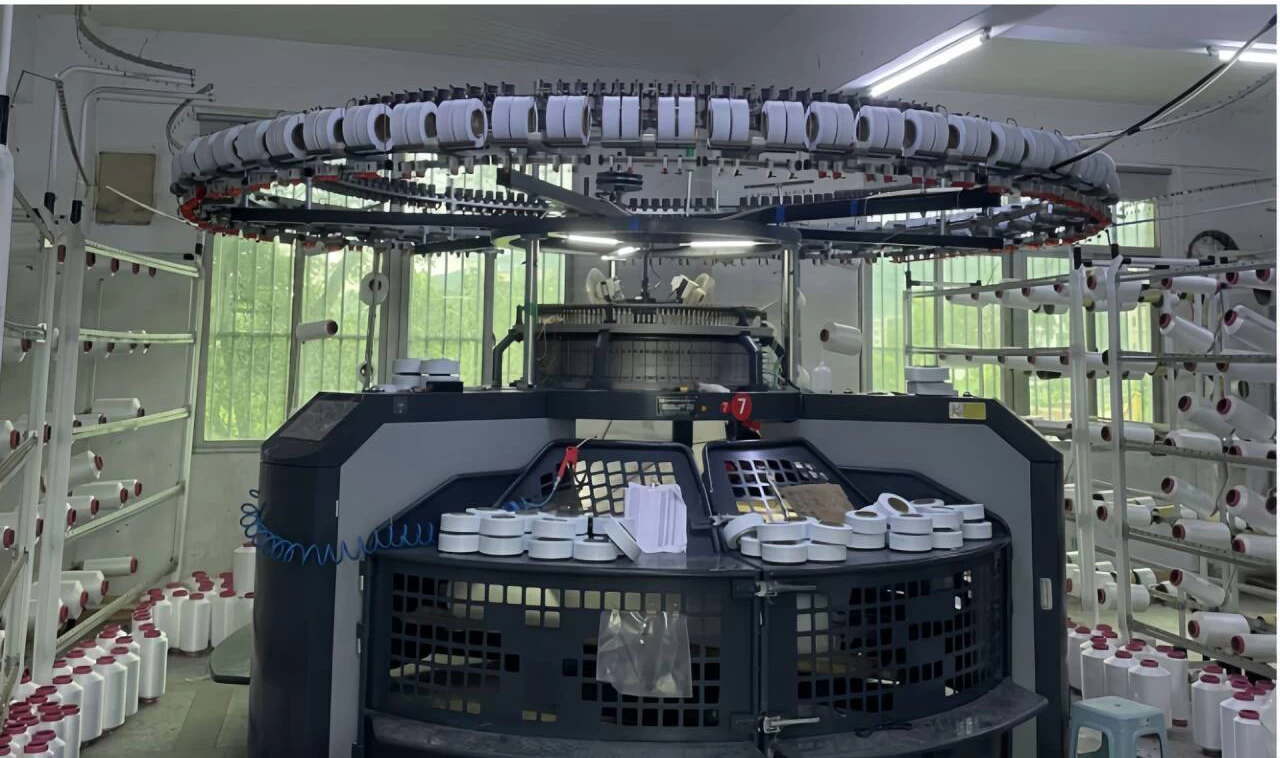
Almost every sourcing conversation about shirts eventually reaches the same set of numbers: weight, yarn count, construction. They appear on quotations, on lab test reports and on the specification sheets that sit behind a purchase order. Yet the same figure is often read differently by a buyer, a fabric mill and a garment factory, and those differing readings are where costly misunderstandings begin.
This article answers the questions we are asked most often about shirt fabric specification. It is written for buyers building a program rather than for textile engineers, so the emphasis is on what each number changes in the finished shirt, and where a specification needs tightening before bulk production starts.
In this article
- What "fabric weight" means on a shirt order
- GSM, oz/yd² and the conversion you actually need
- Yarn count: what 80S, 60S and 40S tell you
- Construction: poplin, oxford, twill, herringbone
- Which weight and construction fits which market
- Where stretch fabrics fit into the weight picture
- Reading a real spec sheet line by line
- Why the sample matters more than the numbers
- Common specification mistakes and how to avoid them
What "fabric weight" means on a shirt order
Fabric weight is the mass of a defined area of woven cloth. In shirts it is normally quoted either in grams per square metre (GSM) or in ounces per square yard. The number is a proxy for three things at once: how substantial the cloth feels in the hand, how much it drapes and hangs, and how resistant it is to showing wear at stress points such as the collar fold and the cuff edge.
What weight does not tell you is quality. A heavy fabric can be loosely woven from short-staple yarn and perform poorly; a light fabric can be tightly woven from fine long-staple yarn and last years. Weight is a design decision about how the shirt should feel and be used, not a ranking.
A practical rule for sourcing conversations: quote weight together with the construction and yarn count. Any one of the three quoted alone is ambiguous enough to cause a mismatch between the sample approved and the bulk shipment delivered.
GSM, oz/yd² and the conversion you actually need
Buyers in the United States frequently work in ounces per square yard while mills in China, Turkey and Portugal quote in GSM. The two are not interchangeable and the conversion is not intuitive, so it is worth having the figures to hand before a specification meeting.
| GSM | Approx. oz/yd² | Typical shirt use |
|---|---|---|
| 95–110 | 2.8–3.2 | Lightweight summer and travel shirts; fine poplin |
| 110–130 | 3.2–3.8 | Standard dress shirt poplin; most business shirting |
| 130–150 | 3.8–4.4 | Mid-weight oxford; year-round business casual |
| 150–180 | 4.4–5.3 | Heavier oxford; work shirts; flannel |
| 180–220 | 5.3–6.5 | Heavyweight twill; utility and industrial shirts |
The conversion factor between the two units is roughly 33.9, so 130 GSM is about 3.8 oz/yd². What matters more than precision is consistency: pick one unit for the whole program and convert the other side rather than quoting in both, which invites rounding errors that compound across a size range.
Yarn count: what 80S, 60S and 40S tell you
Yarn count describes how fine the individual threads are. In the indirect English cotton count system used almost universally for shirtings, a higher number means a finer yarn. An 80S yarn is finer than a 60S, which is finer than a 40S.
- 80S and above. Very fine yarns producing a smooth, almost silky surface. These are the fabrics behind premium dress shirts. They feel superb against the skin but are less abrasion-resistant and demand careful laundering.
- 60S. The workhorse of good business shirting. Fine enough to look sharp under a jacket, robust enough to survive regular wear and commercial laundry.
- 40S. A more substantial yarn with visible texture. Common in oxfords, chambrays and casual shirts where a slightly rustic hand is desirable.
- 20S–30S. Coarse, durable yarns used in heavier work shirts and flannels.
Yarn count interacts directly with weight. You can produce a 130 GSM cloth from fine 80S yarns in a dense weave, or from coarser 40S yarns in a more open weave. Both weigh the same, but the first feels smooth and drapes closely while the second feels dry and textured. This is why weight alone is a poor specification.
One clarification worth making early in any program: "two-ply" and "yarn count" are different things. Two-ply (often written 2/80 or 2/100) means two finer yarns twisted together before weaving, giving strength and a distinct surface character. It is not the same as using a single 80S yarn, and the price difference is real.
Construction: poplin, oxford, twill, herringbone
Construction is the weave pattern — how warp and weft threads cross. It governs surface texture, opacity, breathability and how the cloth creases. Four constructions cover the overwhelming majority of shirt programs.
| Construction | Character | Best suited to |
|---|---|---|
| Poplin / broadcloth | Smooth, flat, fine crosswise ribs, slightly crisp | Formal business shirts, uniform programs |
| Oxford | Basket weave, textured, soft, more opaque | Business casual, button-down collars, casual |
| Twill | Diagonal lines, denser, drapes heavily, wrinkle-hiding | Work shirts, industrial, mid-heavy business |
| Herringbone / dobby | Small repeating geometric patterns in the weave | Fashion shirting, differentiation in a range |
Poplin is the default for formal shirting because its tight, flat surface takes a crisp press and reads as sharp at a distance, which matters in uniform programs where a shirt must look identical across hundreds of wearers. Oxford is softer and slightly heavier at the same yarn count, which is why it became the standard for the button-down collar shirt. Twill hides wrinkles better than either because the diagonal structure deflects light unevenly, and it wears harder, which is why it dominates workwear.
Which weight and construction fits which market
Specification is partly technical and partly commercial. A weight that sells well in one market can fail in another for reasons that have nothing to do with the fabric itself — climate, laundry practice, corporate dress codes and price expectation all push the specification in different directions.
| Market | Climate / practice | Weight most often specified | Notes |
|---|---|---|---|
| United States | Wide climate range; high commercial laundry use | 130–170 GSM, oxford or twill | Durability and colour retention weighted heavily |
| United Kingdom | Temperate; formal dress codes persist | 110–140 GSM poplin | Crisp finish expected; collar structure matters |
| Germany | Temperate; strong workwear and uniform demand | 130–190 GSM, twill | Certification and traceability questions come early |
| Australia | Hot; outdoor and industrial work | 110–150 GSM, breathable | Moisture management and UV considerations |
| Japan | Humid summers; high fabric sensitivity | 100–130 GSM, fine poplin | Surface quality and hand-feel scrutinised closely |
| Middle East | Hot, formal; decorative finishes valued | 110–150 GSM, poplin and dobby | Colour range breadth matters more than durability |
| Southeast Asia | Hot, humid; cost sensitive | 100–130 GSM | Breathability first; price point tight |
Where stretch fabrics fit into the weight picture
Stretch shirtings — usually cotton or cotton-blend woven with a small percentage of elastane, or knitted instead of woven — do not behave like their rigid equivalents on a specification sheet. Because the elastane content allows the cloth to recover after extension, a stretch fabric can be specified slightly lighter than a rigid fabric and still feel substantial, and it tolerates movement across the shoulders and back that a rigid poplin would fight.
Two practical points. First, stretch percentage should be stated as a total, not as an elastane percentage, because the same 3% elastane in a different weave yields different stretch. Second, stretch fabrics require a different assembly approach — seam construction and interlining at the collar and cuffs need to allow for recovery, or the shirt will pucker after washing. If you are specifying stretch, ask for the seam and interlining approach in writing rather than assuming standard construction is used.
For programs that mix rigid and stretch styles in one range, specify each separately. Carrying a single specification across both usually results in one of the two being produced in a construction that does not suit it.
Reading a real spec sheet line by line
A complete shirt specification should let a factory produce the order without further interpretation. The fields we expect to see, and what each one controls, are set out below.
| Field | What it controls | Where it goes wrong |
|---|---|---|
| Fabric composition | Fibre content and blend ratio | Quoted as "cotton" without specifying 100% or a blend |
| Yarn count | Fineness of the threads | Stated as a range so wide it does not constrain the mill |
| Construction / weave | Surface, drape, opacity | Omitted, leaving the mill to default |
| Weight (GSM or oz) | Substance and hand-feel | Unit not stated; buyer and mill read different ones |
| Colour reference | Exact dye target | Described by name only, with no colour standard |
| Shrinkage allowance | Fit after washing | Not specified, or specified without a tolerance band |
| Colour fastness | Fade resistance in laundering | Left to default, which may not match the market |
| Collar and cuff structure | Shape retention | Fused or unfused not stated |
| Stitching density | Seam integrity | Not stated; higher-end programs usually require it |
The recurring theme is that missing fields do not stop production — they simply hand the decision to the mill. That is sometimes acceptable on a low-risk repeat order and rarely acceptable on a new development where the buyer has a specific outcome in mind.
Why the sample matters more than the numbers
Specifications are necessary and insufficient. Two fabrics that match on composition, count, construction and weight can still differ noticeably in hand-feel, lustre and how they behave after five washes, because the numbers do not capture mercerisation, singeing, calendering, yarn quality or finishing chemistry.
This is the reason sampling exists and the reason a sample should not be treated as a formality to be passed as quickly as possible. A pre-production sample made from the actual bulk fabric, washed three to five times under the conditions the end customer will use, tells you more about whether the specification is right than any document. It is also the cheapest possible place to discover that the hand-feel you approved on a swatch does not survive as a finished shirt.
Ask for a wash test on the pre-production sample, not just on the fabric swatch. Swatch performance and finished-garment performance diverge most in shrinkage, colour and collar shape retention.
Common specification mistakes and how to avoid them
The same handful of errors recur across programs of very different sizes. Each one is inexpensive to prevent and expensive to correct after bulk cutting.
- Specifying weight without construction. The mill fills the gap with whatever it has running, and the hand-feel moves.
- Confusing two-ply with yarn count. Results in an under-specified cloth that does not have the durability the buyer expected.
- Leaving the colour reference verbal. A colour name is not a standard; without a physical or numeric reference, batch-to-batch variation is guaranteed.
- Ignoring the wash environment. A shirt specified for cold hand-washing and then industrially laundered will shrink, fade and lose collar shape.
- Carrying one specification across mixed styles. Rigid, stretch and knit constructions need separate specifications even inside one range.
- Skipping the pre-production wash test. The most common cause of a first shipment that passes inspection and disappoints on first wear.
None of these require deeper technical knowledge to avoid. They require the specification to be written completely and read back by both sides before the order is confirmed.
Need help translating a requirement into a fabric specification?
We work from your end use, market and price point to propose a weight, yarn count and construction combination, then confirm it with a pre-production sample and wash test before bulk production begins.
Related reading on this site
Looking for the full fabric range?
Our shirting range covers woven poplin, oxford and twill alongside knitted and seamless constructions. Tell us the construction you are working to and we will confirm what is available on your timeline.