
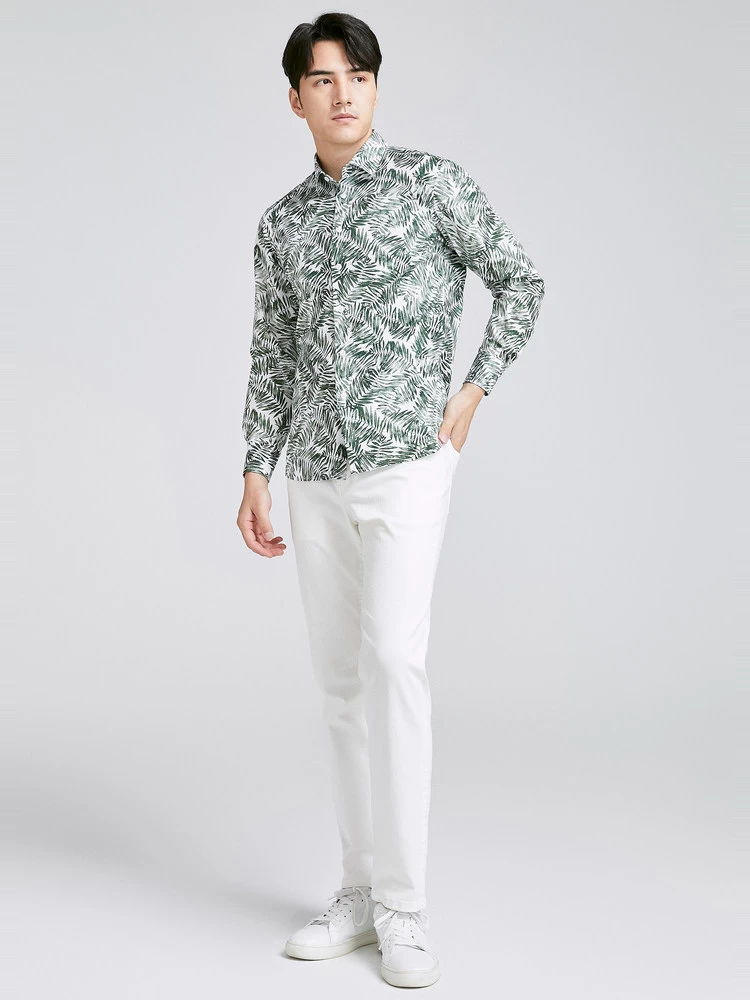
Two shirts can look identical on a product page and behave nothing alike in a warehouse return report. The difference is construction: a knitted shirt is built from interlocking loops, a woven shirt from interlaced yarns. That single fact drives the stretch, the fit tolerance, the grading rules, the shrinkage behaviour and, ultimately, your return rate.
This guide is for buyers choosing between the two for a program, and for buyers already committed to one and trying to avoid the standard mistakes in sizing and sampling.
The manufacturing difference in one paragraph
A woven shirt is cut from fabric woven on a loom, then assembled from panels — front, back, yoke, sleeves, collar, cuffs. Because woven fabric has almost no natural stretch, the garment needs ease: the pattern is drafted wider than the body and the shirt hangs from the shoulders. A knitted shirt is knitted from yarn into a fabric with loop structure, which gives it inherent stretch and recovery. It is either cut and sewn from knitted fabric or, for some knitwear, fully fashioned — knitted to shape panel by panel, which changes both the cost structure and the seam profile.
What each construction is good at
- Woven shirts hold a sharp collar and cuff, drape cleanly, press to a crisp finish, and read formal. They are the correct choice for business dress, hospitality uniform and any program where the shirt must look structured on a hanger.
- Knitted shirts move with the body, resist wrinkling in wear, pack flat without creasing, and tolerate a slimmer cut. They are the correct choice for performance and golf programs, travel ranges, casual retail, and any product where comfort is the selling proposition.
- Knitted jacquard and knitted print go further: the pattern is built into the knit (jacquard) or applied to a knitted ground (print). Jacquard costs more but produces a design that cannot peel or crack; print is cheaper and offers unlimited colour, at the risk of hand-feel changes on the print area.
Stretch changes the size chart
This is where programs go wrong. A size chart copied from a woven shirt and applied to a knitted shirt will produce garments that measure "correct" and fit badly.
- Knitted garments are usually specified with relaxed and stretched measurements. Both need to be in the tech pack, or QC will pass a garment that is technically on-spec and commercially wrong.
- Woven garments are specified with flat measurements plus a tolerance band. The tolerance is where disputes live: ±1 cm on a chest is standard for woven, but on a high-stretch knit the tolerance interacts with the stretch percentage and must be defined separately.
- Recovery matters as much as stretch. A knit that stretches to fit and does not recover will bag at the elbow and hem after two washes. Specify recovery after a defined number of cycles.
Grading: the same size label, a different shape
Grading is how a pattern scales from base size to the rest of the range. Woven and knitted garments do not grade identically.
- Woven shirts typically grade in even increments across chest, waist and sleeve length, with the shoulder width increasing gradually.
- Knitted shirts grade with more attention to the body's circumference change and less to shoulder, because the fabric accommodates the difference. Sleeve length on knits is often held closer to constant across the middle of the range.
- Extended sizes are where this becomes visible. Simply scaling a knit pattern up produces a garment that hangs rather than fits; the armhole and neck opening need re-drafting, not multiplying.
Shrinkage and care behave differently
- Woven cotton shrinks in length and width unless pre-shrunk. Allowance must be built into the pattern so the shirt finishes at the specified measurement after the first wash.
- Knitted cotton and cotton-blend shrinks and can also relax — the garment may shorten in length while widening slightly. Body length allowance on knits is therefore larger than a simple percentage would suggest.
- Elastane-containing fabrics lose recovery over time and are sensitive to heat. The care label and the test wash temperature must agree, or your customers will discover the difference for you.
Sampling: what to test on a knit versus a woven
On a woven shirt, test: collar roll and interlining stability, cuff alignment, placket straightness, match of pattern at the centre front, and shrinkage after wash.
On a knitted shirt, test: neckline recovery after repeated stretch, shoulder seam stability, hem curl, pilling after abrasion, and the relaxed-versus-stretched measurement pair after washing.
Both need the same commercial checks: measurement against spec, colour against the approved standard under defined lighting, and a wear trial on a real body rather than a mannequin.
A selection framework
- Define the use case — formal, uniform, performance, casual or seasonal.
- Choose construction before styling. Collar shape and placket are downstream of knit versus woven.
- Choose the fabric within that construction — count, weight, fibre, finishing.
- Write both measurement sets for knits (relaxed and stretched) and a tolerance band for wovens.
- Decide the grading rule and confirm it with the pattern maker before sampling, not after.
- Approve on a washed sample, not a fresh one.
Where the returns actually come from
- Woven shirts returned for tight armholes and short body length — a grading problem, not a fabric problem.
- Knitted shirts returned for a stretched-out neckline — a recovery specification that was never written down.
- Both returned for shrinkage after the first wash — an allowance that was assumed rather than measured.
None of these are visible in a product photo and all of them are preventable in the tech pack.
SEEWEED produces both woven and knitted shirts in the same facility, with fabric development in-house — so the construction decision and the fabric decision can be made against the same sample set. See the custom shirt range or send us your tech pack.